
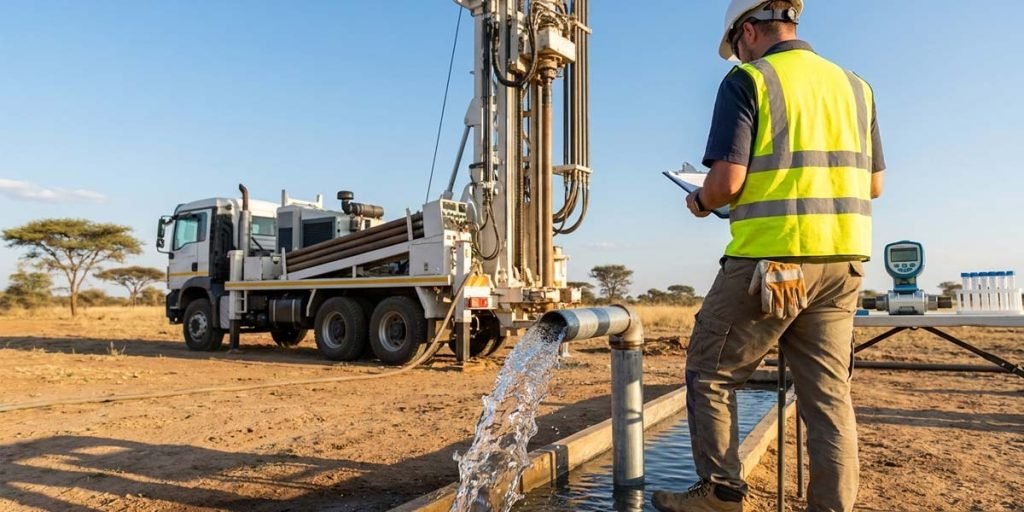
Water supply infrastructure projects frequently face operational setbacks. While public attention often focuses on the failure of surface hand pumps, the failure of an entire borehole is far more costly and difficult to remedy. Poor design, faulty construction, and inadequate supervision are the primary causes behind non-functioning boreholes, and rectifying structural issues once drilling is finished is exceptionally difficult.
When proper technical standards are observed, a well-constructed borehole provides a clean, reliable water supply for generations. This technical guide outlines what can go wrong during drilling and how rigorous supervision ensures long-term infrastructure investment protection.
The High Cost of Poor Construction
Across Africa, constructing a single borehole requires an investment ranging between $1,000 and $25,000. When construction standards are compromised, boreholes can stop functioning within hours, days, weeks, or months of completion. This leaves communities without usable water and results in a complete waste of capital.
When government officials and community leaders receive complaints about failing water points, the root cause is frequently traced back to poor design, improper construction, and a lack of independent oversight.
Common Technical Flaws in Borehole Drilling
Several critical errors during the drilling process can undermine the viability of a water source:
Incorrect Drilling Depth: Drilling too shallow leaves the borehole without sufficient water during dry seasons. Conversely, drilling unnecessarily deep incurs excessive, avoidable costs.
Poor Structural Construction: Flawed installation can physically prevent groundwater from flowing into the well.
Inadequate Well Development: Failing to properly develop the well allows fine particulate matter to enter, clogging pumping equipment and ruining the installation.
Essential Requirements for a Lifetime Borehole
To ensure a borehole provides a continuous, high-yielding water supply, projects must follow a strict quality-assurance process.
- Proper Site Selection
The drilling location must be selected carefully to ensure it is positioned at a safe distance from any potential source of contamination. - Dedicated, Full-Time Professional Supervision
Contracting a reputable drilling company is essential, but it is equally critical to engage an independent, qualified supervisor such as a geologist, hydrogeologist, or retrained engineer.
Continuous Presence: Spot-checking is insufficient. The supervisor must be present on-site at all times during drilling to adapt engineering designs to actual ground conditions.
Quality Assurance: The supervisor ensures all technical specifications are met and prevents substandard practices.
- Key Execution & Completion Steps
During execution, the supervisor oversees several non-negotiable technical procedures:
Straightness & Depth: Verifying that the hole is drilled straight and to the exact depth required for optimal inflow.
Screen Placement & Casing Grade: Positioning the well screen correctly and installing the specified grade of casing.
Gravel Pack & Sanitary Seal: Filling the annulus with clean, properly graded gravel pack material and applying a cement grout sanitary seal to block surface contamination.
Air Flushing: Flushing the borehole repeatedly using compressed air until the discharged water is completely clear of fine materials.
Yield & Quality Testing: Pumping the well continuously for several hours to measure yield accurately, followed by water quality testing.
Data Logging: Collecting and submitting all technical data and drilling records to the appropriate governing agency.
Protecting the Investment: The ROI of Supervision
Enlisting a professional drilling supervisor costs approximately $500, yet this modest outlay can protect against a failed borehole costing over $10,000.
To maintain industry standards and prevent compromised installations, drillers or supervisors who deliver poor work or collude to sign off on low-yielding wells should be recommended for disqualification. Project developers and managers must never leave execution entirely in the hands of the driller. Rigorous oversight is the single most effective guarantee of long-term success.