
When a water hand pump or extraction system stops working, the immediate assumption is often a mechanical failure above ground. However, technicians frequently discover that the underlying problem stems from the borehole structure itself rather than the pump mechanism. Diagnosing performance issues beneath the surface requires thinking like both a mechanic and a hydrogeological detective.
To ensure long-term water security, Sumadhura Technologies Ltd highlights the key engineering principles that separate a reliable, high-yielding borehole from one prone to premature failure.
Strategic Siting and Contamination Prevention
A successful borehole project begins long before drilling equipment arrives on site.
Safe Separation Distances: The borehole must be positioned far enough from potential contamination sources, including latrines, cemeteries, and waste dumps. While maintaining adequate distance can be challenging on smaller land plots, it is essential for protecting water quality.
Site-Specific Hydrogeology: Local subsurface conditions vary significantly across drill sites. Engineers must review historical data from neighboring wells and adjust drilling specifications directly on site to match actual ground formations.
Structural Integrity: Quality Casing & Materials
Installing substandard materials to lower upfront costs is a leading cause of catastrophic well failure.
Sufficient Casing Thickness: Casing pipes must possess adequate wall thickness and structural strength. Utilizing thin or improper piping such as thin drain pipes can cause the well walls to collapse shortly after installation.
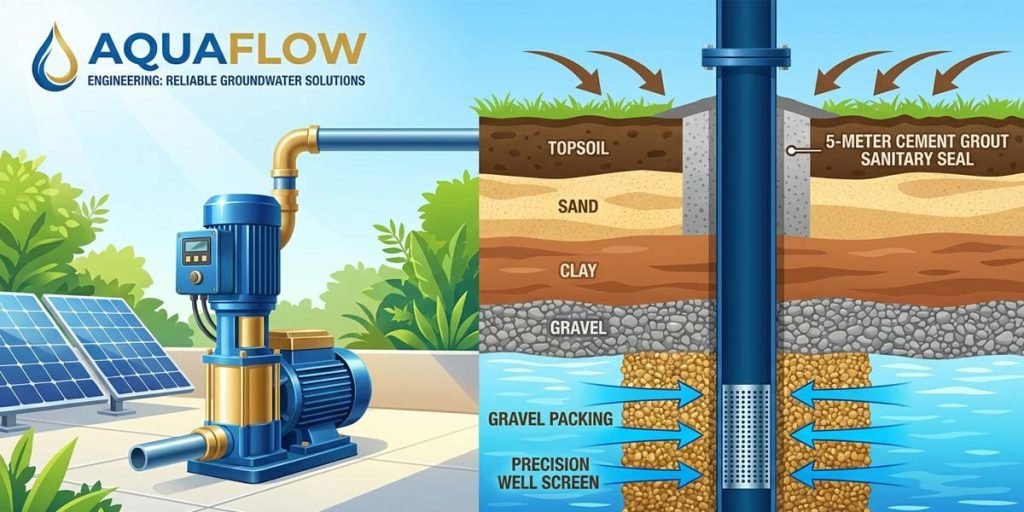
Precise Screen Placement and Slot Sizing
The well screen allows groundwater to enter the casing while blocking surrounding formation materials.
Targeted Depth & Seasonal Allowance: The well must be drilled deep enough to position the screen directly opposite the water-bearing rock or sediment formation. The design must also account for seasonal fluctuations in the water table.
Controlling Inflow & Silting: Placing the screen in the wrong location results in insufficient water inflow. Furthermore, if screen slots are sized too large for the formation, sand and sediment will enter the well and cause severe silting.
Proper Gravel Packing and Backfilling
One of the most frequent mistakes during construction involves incorrect gravel pack selection.
Uniform Particle Sizing: The gravel pack or formation stabilizer must consist of clean material with uniform particle sizes specifically matched to the screen slots. Using fine dust or irregular gravel chippings will compromise water filtration.
Controlled Installation: The gravel pack must be poured according to technical guidance and backfilled using appropriate drilled cuttings above the intake zone.
Sanitary Cement Grout Sealing
Preventing surface runoff from infiltrating the groundwater supply is a vital safety requirement.
5-Metre Sanitary Seal: Boreholes must be properly sealed with a cement grout seal extending at least 5 metres deep. Omitting or rushing the grouting process allows contaminated surface water to drain directly into the drinking water supply.
Comprehensive Well Development
Well development is the process of flushing out dirty water, fine sediments, and drill cuttings from the borehole.
Unobstructed Water Flow: Thorough development ensures that groundwater can flow freely into the casing without resistance.
Preventing Silt Accumulation: When drillers rush or skip development, the well rapidly fills with silt. Silting is one of the primary reasons boreholes fail permanently and become impossible to repair.
Rigorous Test Pumping
Before a borehole is commissioned for public or commercial use, it must undergo test pumping. This empirical testing verifies the yield of the aquifer and confirms that the borehole can supply a sufficient volume of water over time.
Summary: Quality Engineering Delivers Lasting Water Solutions
Constructing a durable borehole requires trained, licensed, and properly supervised drilling specialists. Adhering to strict hydrogeological standards ensures that communities and commercial facilities enjoy a safe, continuous water supply for years to come.
For readers seeking further technical standards on borehole design and construction, the resource book Developing Groundwater is available for download from the Practical Action website.